
Parties in Bangladesh sign reform charter following violent uprising
In Bangladesh, more than a year has passed since the ousting of former Prime Minister Sheikh Hasina. The transitional government now wants to introduce reforms and presents a Charter therefore. What are these reforms about, and who is participating and who is refusing to do so?
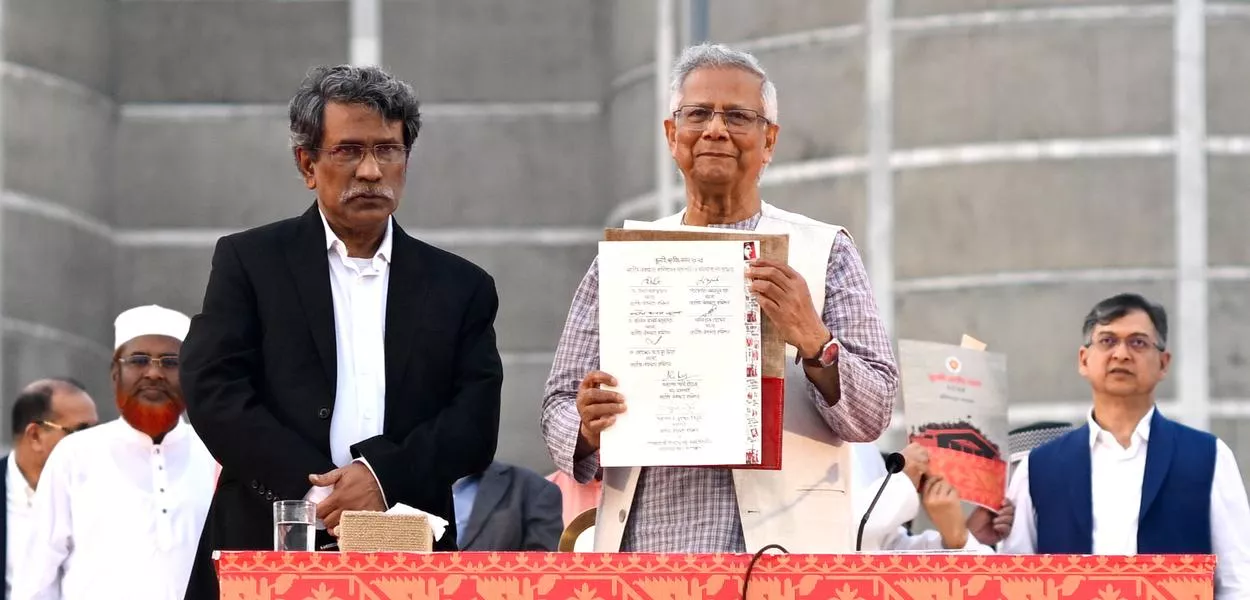
Dhaka (dpa) – Bangladesh's major political parties have signed a document on Friday pledging to implement a comprehensive state reform agenda advanced by the interim administration installed after last year’s violent uprising that ousted former prime minister Sheikh Hasina.
The signing ceremony took place near the national parliament building in Dhaka. It was preceded by brief clashes between security forces and protesters who had fought against Hasina during the uprising. Police used sound grenades and tear gas to disperse the crowd hours before the head of the interim administration, Muhammad Yunus, and his council of advisers arrived. Protesters vandalized vehicles and set fire to furniture at the venue.
"The beginning of a new Bangladesh": Yunus
Yunus, who also leads the National Consensus Commission formed after the interim government was installed, signed the "July National Charter 2025" alongside the political parties. After the signing he said the document marked "the beginning of a new Bangladesh."
The charter proposes sweeping reforms across all three branches of the state: the legislature, executive and judiciary. It also grants indemnity to participants of the uprising, promises compensation to the families of those killed and rehabilitation for the injured. The commission finalized the charter following months of dialogue with 33 political parties that took part in the anti-Hasina protests. Hasina’s Awami League party, whose activities are currently banned, and its allies were not involved in the eight-month-long discussions on the reform agenda.
Signatories include the Bangladesh Nationalist Party (BNP) of former prime minister Khaleda Zia and the largest religious party, Bangladesh Jamaat-e-Islami. However, the National Citizen Party (NCP), formed in February by the students who led the mass uprising — along with four other left-leaning parties — declined to sign.
84 reform measures for discussion
Yunus took office three days after Hasina fled to neighbouring India amid the protests on August 5, 2024. His administration proposed 84 reform measures for discussion, including limiting an individual’s tenure as prime minister to no more than 10 years, introducing a bicameral parliament, rebalancing power between the president and the prime minister, and ensuring the total independence of the judiciary from the executive branch. It also proposed restructuring the election commission and reforming the police and civil administration.
“These measures are aimed at reducing the abuse of state power and ensuring accountability at all levels of government,” said Ali Riaz, vice chairman of the commission.
Charter is critical of the recent past
The document traces Bangladesh’s political history from the British colonial era through key events such as the 1952 Language Movement and the 1971 Liberation War. It details the post-independence landscape, including the return to multi-party democracy in 1978. The charter is critical of the recent past, accusing the Awami League government — in power since 2009 — of gradually discarding democratic values and adopting an “undemocratic and fascist character.” It alleges the government established a “reign of chaotic and horrific terror” through enforced disappearances, extrajudicial killings and the persecution of critics.
It further accuses the government of undermining the electoral system by holding “three consecutive controversial and farcical elections” in 2014, 2018 and 2024, and of “institutionalizing partisan influence” to control state institutions and enable corruption. The charter notes that the 2024 uprising revealed a powerful public demand for comprehensive state reform and urged political party representatives to uphold the will of the people and govern based on democratic principles and national consensus.