Loading article...
Trusted news agencies tracing tendencies of democratisation and autocratisation globally
Trusted news agencies tracing tendencies of democratisation and autocratisation globally
Loading article...
The far-right Alternative for Germany is on the brink of power in one of the country's 16 federal states. An electoral mechanism intended to keep out minor parties could tip the balance.
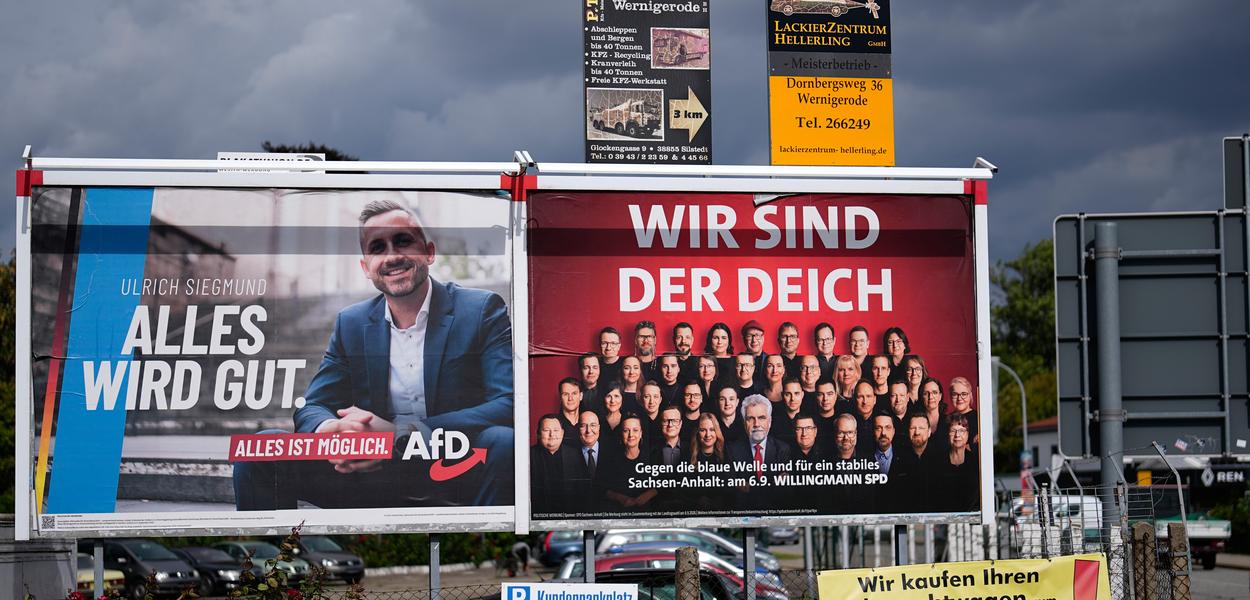
Magdeburg (dpa) - The German electoral system is designed to create stable governments - and to keep minor parties, often at the extreme ends of the political spectrum, out of power.
It's a lesson drawn from the country's dark 20th century history, when political fragmentation assisted the Nazis' rise to power under the failed Weimar Republic.
Hoping to create a more stable democracy, post-war West Germany developed a new electoral framework that consolidated the party system.
In a 1953 speech, conservative lawmaker Gerhard Schröder - later the West German foreign minister - said the new law's purpose was to "counteract the fragmentation that threatens the survival and development of the parliamentary democratic system."
The system has survived largely intact to this day in the reunified country. Yet with a far-right party on the verge of taking power in a German state on Sunday for the first time since World War II, one part of the electoral law has suddenly become more important than ever.
Elections at the national and state level in modern-day Germany require parties to secure 5% of the total vote, or win three constituencies outright, to gain a proportional share of seats in parliament.
Falling short effectively wipes out a minor party's voters from the equation, lowering the share needed by other parties to cobble together majorities and form workable governments.
The current national coalition between Chancellor Friedrich Merz's conservatives and the centre-left Social Democrats (SPD), for example, holds a narrow majority of seats in the Bundestag - Germany's lower house of parliament - despite earning a combined vote share of just under 45% in the 2025 election.
This was largely due to the populist Sahra Wagenknecht Alliance (BSW) missing out on the 5% threshold by a whisker after earning 4.98% of the vote.
But this time the tables are turned: Instead of easing the path to majorities for the traditional mainstream parties, the surging popularity of the Alternative for Germany (AfD) in the eastern state of Saxony-Anhalt, combined with the 5% hurdle, could bring a party on the far end of the political spectrum into power.
Since its founding in 2013, the Alternative for Germany (AfD) has morphed from a eurosceptic fringe group to the country's largest opposition party, shifting ever further to the right on its central issue, immigration, following the 2015 refugee crisis.
Last year, the populist party was classified as a "confirmed" right-wing extremist movement by domestic intelligence services, although use of the label was suspended pending a court ruling.
The AfD's branch in Saxony-Anhalt is seen as particularly influenced by far-right ideologies and has likewise been classified a "confirmed" extremist group since 2023, allowing intelligence authorities in the state to monitor the party.
Yet warnings of the party's far-right tendencies have not deterred many German voters in recent years. In Saxony-Anhalt, the party has consistently polled above 40% in the run-up to Sunday's election.
Up until now, the AfD has never participated in a governing coalition in Germany's 16 states or its federal government, as all other mainstream parties have refused to work with it, a stance famously known as the "firewall."
Saxony-Anhalt, however, could offer the AfD an opportunity to bypass the firewall entirely by securing an unprecedented absolute majority of seats in the state parliament in Magdeburg.
The party is not expected to get 50% of the vote, but, assisted by the 5% clause, it might not have to.
Recent polling suggests three parties - the BSW, the Greens and the pro-business Free Democrats (FDP) - could fail to break the 5% mark in Saxony-Anhalt, with the SPD hovering just above the threshold.
Should three of the four parties not make it, the AfD would likely be left requiring only around 43% of the vote to win a majority in Magdeburg and become the first far-right party to lead a state government in Germany since the Nazis.
Such a scenario already exists: In the western state of Saarland, the SPD leads a single-party majority government after winning 43.5% of the vote in the 2022 election, with several parties having fallen short of the 5% threshold.
The prospect of an outright AfD victory has prompted a last-ditch campaign to encourage tactical voting among left-wing parties, led by campaigning group Campact, to ensure both the Greens and SPD enter the state parliament.
Watching her two young children play in the water fountains on Magdeburg’s Cathedral Square, one woman who had already voted by post - and who did not want to give her name - tells dpa left-wing voters are well aware of the situation. “I voted tactically,” she confirms.