Loading article...
Trusted news agencies tracing tendencies of democratisation and autocratisation globally

Trusted news agencies tracing tendencies of democratisation and autocratisation globally
Loading article...
For the past five years, the Taliban have banned girls in Afghanistan from receiving secondary education and from attending university. But there are still some places where girls can receive an education. How does this work?
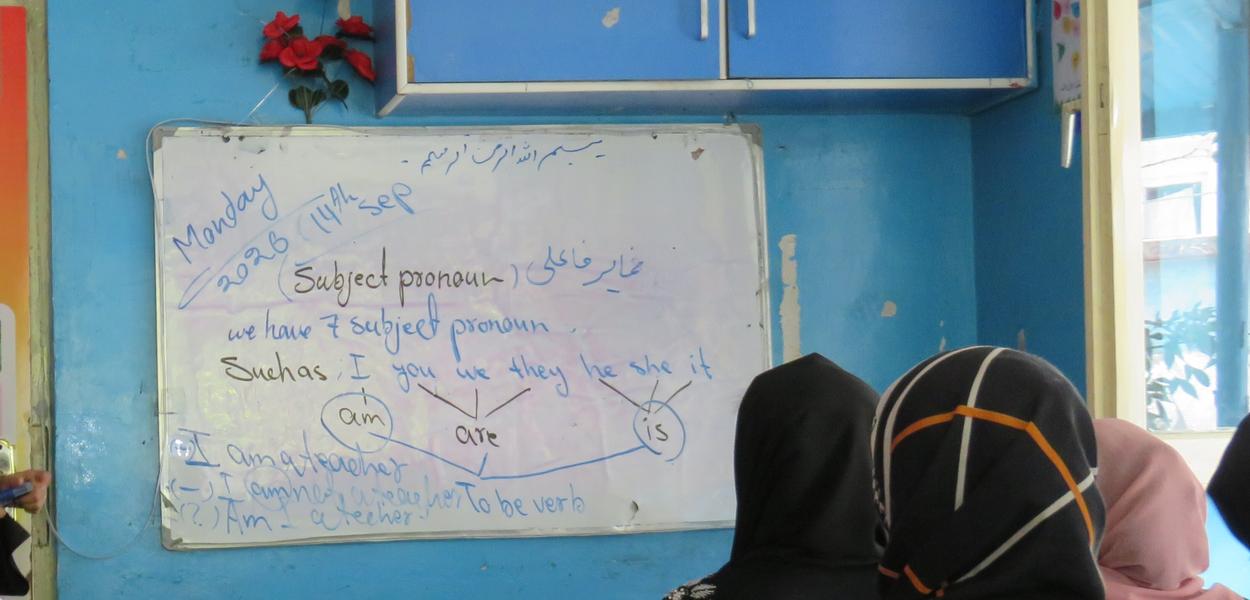
Islamabad (dpa) - It looks just like any ordinary Afghan school. After lessons have finished, children and slightly older girls wearing white headscarves run across the playground. Standing amidst the hustle and bustle, the headteacher says she is afraid the Taliban might find out what they are doing there. “Then they might close our school.”
The Islamist Taliban have been back in power in Afghanistan for more than five years. Even when they took power in August 2021, leading members of the Taliban had spoken of women retaining access to education. Following the closures due to the coronavirus pandemic, schools were due to reopen on 18 September. But the reopening for girls from Year 7 onwards was first postponed – and then suspended altogether.
Since then, 2.6 million girls have been barred from attending secondary school, the UN Children’s Fund, UNICEF, reported a month ago. Afghanistan is the only country where women and girls are explicitly excluded from higher education.
Yet at this school, which looks so normal at first glance, girls’ education continues beyond Year 6. For security reasons, the school’s location cannot be disclosed. Pupils, teachers and the management speak to the Deutsche Presse-Agentur only on condition of anonymity.
English lessons, which the school also offers, could in particular lead to problems very quickly under Taliban rule. For the teacher running the course, however, it is precisely these lessons that are so important: the devices she uses every day are set to English. And "in the age of AI, we simply all need to be able to speak English", she emphasises.
In addition, further training courses in beauty therapy and dressmaking are on offer. Beauty salons are now technically banned as a trade for women. But, says one student, she does not want to waste her time. She wants to learn at least something. Such training courses are not necessarily completely banned in Afghanistan – but the implementation of the regulations often depends on the interpretation of local Taliban officials.
When questioned about their ban on education for women, members of the Taliban government repeatedly cite alleged Islamic values. In an interview with the US broadcaster CBS News on Tuesday, Foreign Ministry spokesperson Abdul Kahar Balchi said that whilst secondary education for women and girls was currently suspended, this did not curtail their right to a basic education. He went on to say that home schooling, online lessons and religious schools are permitted.
This grey area also provides some leeway for the Cologne-based organisation ‘Anar Academy’, which offers online lessons in subjects for Years 7 to 12 to girls in Afghanistan. More than 1,400 schoolgirls have been enrolled in the programme nationwide this year, says the head of the Anar Academy, Benazir Poya. However, many are unable to complete it, often due to internet problems or because the country’s difficult economic situation is putting a strain on families.
Afghanistan is currently experiencing a severe humanitarian crisis. At the same time, international funding for the country is declining at an ever-increasing rate. By the end of August, only just under 30 per cent of the funds planned for the current year had been received, according to the United Nations. Meanwhile, hunger is spreading and medical care is deteriorating rapidly.
It is a Tuesday morning, and pupils are gradually trickling into the digital classroom to take part in the online lesson run by the Anar Academy. Some arrive a little later; one pupil asks in the chat: "Is the teacher here yet?"
Just under 30 pupils gather, and the teacher does indeed arrive a little later. She explains later that she first had to sort out her internet connection and was teaching from a hilltop.
Then the English lesson begins. The Year 12 pupils discuss presentations on various topics with one another. In one presentation, a girl talks about the threats posed by artificial intelligence to global employment trends; in another, a pupil explains historical methods for determining the direction of Muslim prayer based on star constellations.
The lessons take place under security precautions – particularly for the teachers, explains the head of the Cologne-based organisation. One of their teachers was arrested and beaten by the security authorities two years ago. They had to close a secret school they had been running in the north of the country – the fear of repression was too great.
In the online classroom, the 12th-year girls at Anar Academy move straight on to maths after their English lesson. Before that, however, some of them want to get something off their chests: online lessons can never bridge the gap with face-to-face teaching. But they won’t give up, says one. Another says she doesn’t want her children to see her as an illiterate mother who did nothing but give birth. “I refuse to remain uneducated," she says.
However, the head of the state’s face-to-face school also recognises the shortcomings of online teaching. During the pandemic, she notes, it became clear just how exhausting it is. ‘The girls aren’t prisoners who should be confined to their homes for their whole lives. It’s good for them to get together, have a circle of friends and have the opportunity to interact with others.’
Mathis Richtmann, dpa